
Before getting a tag engraved, the same question always comes up: How much should I put on it? The instinct is understandable: The more information on the tag, the easier it is for the person who finds the dog. However, the reverse is also true: Anything on the tag can be read by anyone who gets close enough to the animal. Even someone who didn’t find it at all.
This post goes through the usual details, explains what each one actually accomplishes and what it reveals—and shows a way out of the dilemma.
The four usual details, considered individually
- The animal’s name. Practically harmless and actually useful: A dog called by name is more likely to stop. The only objection is an old point of contention among dog owners: A name makes it easier to lure an animal. For the vast majority of situations, however, the benefits outweigh the drawbacks.
- Your phone number. The fastest way to get in touch. And at the same time, the piece of information you’re permanently handing over to a stranger. A cell phone number often leads directly to the owner’s name—and sometimes to their address—via a reverse lookup. Most people who read a number on a collar will call and return the animal. The question is whether you want that for everyone else, too.
- Your address. This is where it gets uncomfortable. An address on a collar means that anyone who sees the dog knows where you live—and often also that no one is home right now because you’re out. I would strongly advise against including this information.
- The microchip number. It looks like the safe solution, but it’s useless to the person who finds the dog. Only those with access to a pet registry can look up a fifteen-digit number—such as a veterinarian, animal shelter, or government agency. The neighbor who finds your dog on the street at 10 p.m. can’t do anything with it.
The microchip and the tag solve different problems
Microchip identification is required in many countries and is almost always a prerequisite for traveling with your pet. Each country determines its own procedures for registration and which registry is responsible. You can obtain this information from your veterinarian or the relevant local authority. No tag can replace the microchip, and this article isn’t discouraging anyone from using it.
However, the microchip is designed for a different scenario: it comes into play after an animal has been taken to a specialized facility. It doesn’t help in the hour leading up to that—and it’s precisely that hour that’s usually crucial. A dog sitting in the finder’s living room will be returned faster than one that first has to go through an animal shelter and depend on its opening hours.
So the microchip and the tag solve problems that occur sequentially. The tag enables a quick return; the microchip forms the safety net underneath.
The Solution: Be Reachable Without Being Legible
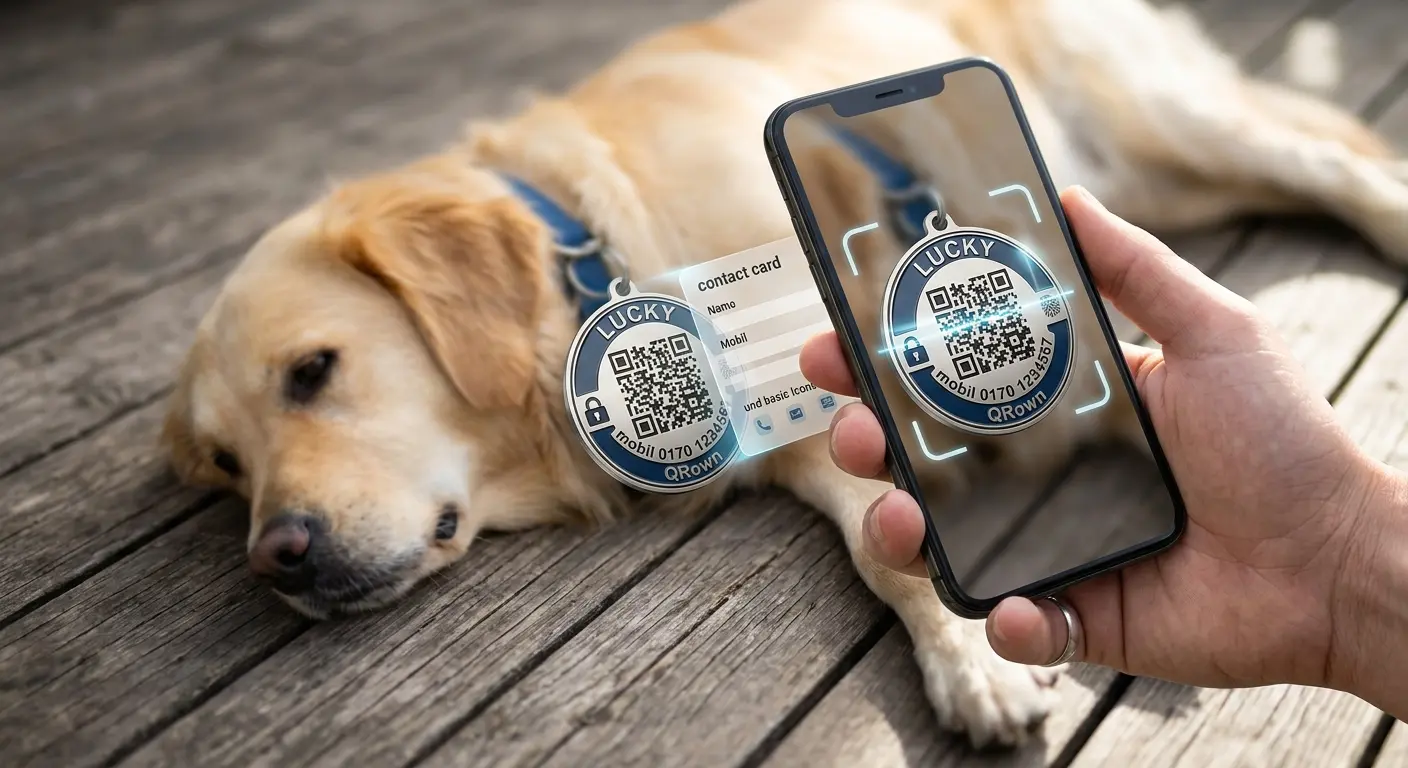
There’s a third option that resolves the dilemma: Instead of your personal information, the tag features a QR code.
The finder scans it with their phone—no app, no account needed—and is taken to a page that displays exactly what you’ve specified in advance. You can choose to display your number directly or show only a short form. The finder writes where they found the animal and, optionally, shares their location. You receive a notification including the location where the animal was found. They never see your number or address.
The difference from an engraved number isn’t the speed—both result in a phone call. The difference is that you can change the contact information at any time. New number? On vacation with a different contact person? You change the contact details; the tag on the collar stays the same.
One side effect that’s especially important when traveling is that a QR code knows no national borders. Anyone who finds your pet abroad will land on the same page as a neighbor back home—without an area code and without having to figure out which registry is responsible in that country.
Dogs and cats are different cases
With dogs, the finder is almost always a person who takes active steps. They hold onto the animal, look for something legible, and call. What matters here is that the information works immediately and without any detours.
With cats, it’s different. Outdoor cats are rarely “found”—they show up somewhere and are fed for weeks because it’s unclear whether they belong to anyone. A visible code on the collar answers exactly that question: This animal has an owner. A safety collar with a breakaway clasp is essential here, because a collar that doesn’t open if it gets caught on something poses a real risk.
What Really Matters in the First Hour
When a pet goes missing, it’s not technology that matters, but how easy you make it for the person who finds it:
- Information that works immediately is crucial. If someone has to search for details or find a registry first, they’re much less likely to call at all.
- A note indicating that the animal is missing. Not everyone recognizes a stray dog as such. If the code links to a page where you can briefly note this, the situation is immediately clear.
- There’s no obligation to drive to the animal shelter. Many finders simply don’t have time for that—and then give up.
Frequently Asked Questions
Does the QR code replace the microchip?
No, and it’s not meant to. Where microchipping is required by law, it remains mandatory and establishes a connection to a specialized agency in an emergency. The QR code covers the time before that.
What happens if the person who finds the dog doesn’t have a smartphone?
Then all the information already on the tag—the pet’s name and, if applicable, your phone number—will be used. The QR code is an additional option, but not the only one.
Does this work abroad?
Yes. A QR code isn’t tied to any national border or national registry—the page it links to opens the same way everywhere. For longer trips, you can also enter a temporary vacation address that disappears once the date expires.
In what language will the person who finds the pet see the page?
On QRown, in its own language. The landing page adjusts to the device’s language. So whoever finds your pet while traveling won’t have to guess what it says.
Will this kind of tag last in everyday use?
That depends on the material, not the code. Engraved tags or those sealed under synthetic resin can withstand rain and mud, whereas a paper code glued to a collar cannot.
Does it cost anything?
You can create a QR code for this purpose with a free account on QRown. Costs only apply if you need more than two such codes—for example, for multiple pets.
In summary
You can include the pet’s name. It’s better not to include your address. As for the phone number, you’ll need to decide whether you want to share it with anyone who comes into contact with the pet.
A QR code takes this decision out of your hands. You remain immediately reachable without having any personal information on the collar.
If you’re already in the process of labeling your suitcase, keys, or bike: There’s a separate post about lost items and how to get them back.
Create a QR code for your pet tag for free now.