
Dynamic vs. Static QR Codes: The Difference Explained Simply
Do you want to create a QR code but aren’t sure whether you need a static or a dynamic one? In this article, you’ll learn the differences so you can make the right choice for your specific use case.
What exactly is a QR code?
A QR code is basically a visual representation of information—like a barcode, only smarter. When you scan it with your smartphone, something happens: A website opens, text appears, or contact information is saved.
But here’s the key point: There are two fundamentally different ways a QR code can work.
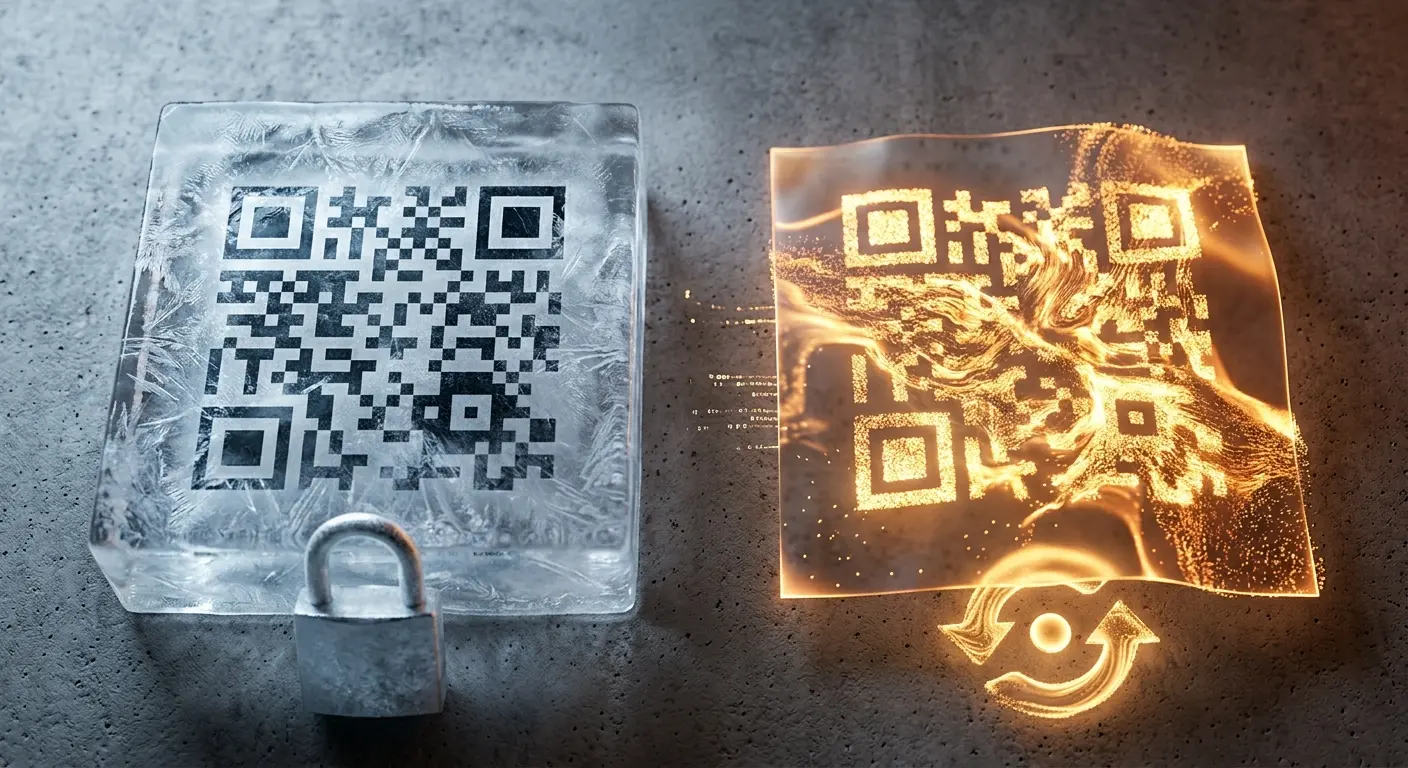
Static QR Code: The information is stored directly in the code
Imagine writing a message on a piece of paper and putting it in an envelope. The message is fixed—what’s written on the paper stays there forever.
This is how a static QR code works
The information (e.g., a web address) is embedded directly into the black pattern of the QR code when it’s created. When someone scans the code, the smartphone reads this information directly from the pattern.
Example: You create a QR code for https://www.ihr-restaurant.ch/speisekarte. This entire URL is now encoded in the black and white squares. Every scan leads directly to this address—with no detours.
The scanning process
- Smartphone scans the code
- Reads the URL from the pattern
- Opens the website
Advantages of static QR codes
- Independence: The code functions completely on its own. No server or intermediary is needed, since the smartphone reads the data directly. Even if the QR code provider goes out of business, your code will continue to work.
- Privacy: Nothing is tracked, and no IP addresses are stored. Scanning leaves no digital traces.
- Often free: Many basic generators offer static QR codes with no restrictions. However, professional features like logo integration or design customizations often cost money, even for static codes.
Disadvantages of static QR codes
- Cannot be changed: This is the biggest disadvantage. Once created, the information is permanently embedded in the code. Did you make a typo in the URL? Too bad. Does the website need to move? All codes are useless.
- Complexity with long URLs: The more characters you encode, the denser and more complex the QR code pattern becomes. A long URL like https://www.mein-unternehmen.ch/produkte/kategorie/unterkategorie/artikel-123 generates a very complex code that’s harder to scan.
- No statistics: There are no statistics, so you’ll never know if or how often someone has scanned the code. For individuals, this usually doesn’t matter, but for businesses, it’s a problem.
Dynamic QR Code: The Code Acts as a Sort of Signpost
Now here’s the clever part. Imagine the envelope doesn’t contain a direct message, but only an instruction: “Go to locker 42, compartment 3—the current message is there.”
How a dynamic QR code works
The QR code doesn’t contain the actual destination address, but rather a short redirect URL. This short URL points to a server, which then redirects to the actual destination. And you can change this redirect at any time.
Example: Your QR code contains https://qrown.io/abc123. Currently, this short URL redirects to your menu. Starting tomorrow, you can set it up so that abc123 redirects to your daily special—without having to change the printed QR code.
Here’s how the scanning process works
- Smartphone scans code
- Smartphone reads short URL
- Server redirects
- Destination page opens
Advantages of dynamic QR codes
Editable: This is the main advantage. Did you print 5,000 flyers and notice an error in the URL? No problem—just change the redirect destination in the dashboard.
Statistics: Since every scan goes through the server, you can track the following.
- How many people scanned the code?
- When was it scanned? (Time, day of the week)
- Where was it scanned? (Country, city)
- Which device? (iPhone, Android, etc.)
More compact code: The short URL is always the same length (e.g., 25 characters), no matter how long the destination URL is. The pattern remains simple and easy to scan.
Flexibility: You can implement various scenarios.
- Seasonal offers (a different landing page in winter than in summer)
- A/B testing (50% of scans go to Page A, 50% to Page B)
- Time-based triggering (automatically redirects to the Christmas offer starting December 1)
Disadvantages of dynamic QR codes
Costs: Most providers charge a monthly or annual fee. Typical rates range from 5 to 50 euros per month, depending on the feature set and number of codes.
Dependency: Your code only works as long as:
- Your subscription is active
- The provider operates the service
- Their servers are accessible
If the provider discontinues the service, your codes are worthless.
Detour: Scanning takes slightly longer (usually 100–300 milliseconds) because the data must be routed through the server. In practice, this is barely noticeable.
Data protection: Data is collected during scanning (IP address, location, device). Operators must handle this data in compliance with the GDPR and provide a privacy policy as well as a cookie notice.
Create your first static or dynamic QR code now: --> https://qrown.io/