
How Much Data Can a QR Code Hold? (And When Does It Break Down?)
When you look at a QR code, you usually see nothing more than an abstract mosaic of black and white squares. But how much information can actually be stored in these two-dimensional patterns, and what happens when the limit is reached?
The answer ranges from astonishing capacities to tangible problems with readability in everyday life.
The Limit in Numbers: A Memory Marvel—With Conditions
The storage capacity of a QR code isn’t fixed. It varies greatly depending on the type of information entered.
If you want to store only numbers, you benefit from extremely efficient compression. However, if special characters, umlauts, or lowercase letters are used, the available space shrinks drastically.
- Pure number sequences: Up to 7,089 digits (e.g., for meter readings or serial numbers).
- Standard text (uppercase letters & numbers): Up to 4,296 characters.
- Modern web content & special characters: Maximum 2,953 bytes (UTF-8 encoding).
The Catch with Umlauts and UTF-8
The Catch with Umlauts and UTF-8: One byte does not necessarily correspond to one letter. While standard characters like “A” or “1” take up exactly one byte, German umlauts (ä, ö, ü) or emojis can take up multiple bytes. Text containing many special characters therefore reaches the upper limit much more quickly.
What Happens in the Grid? The Principle of Versions
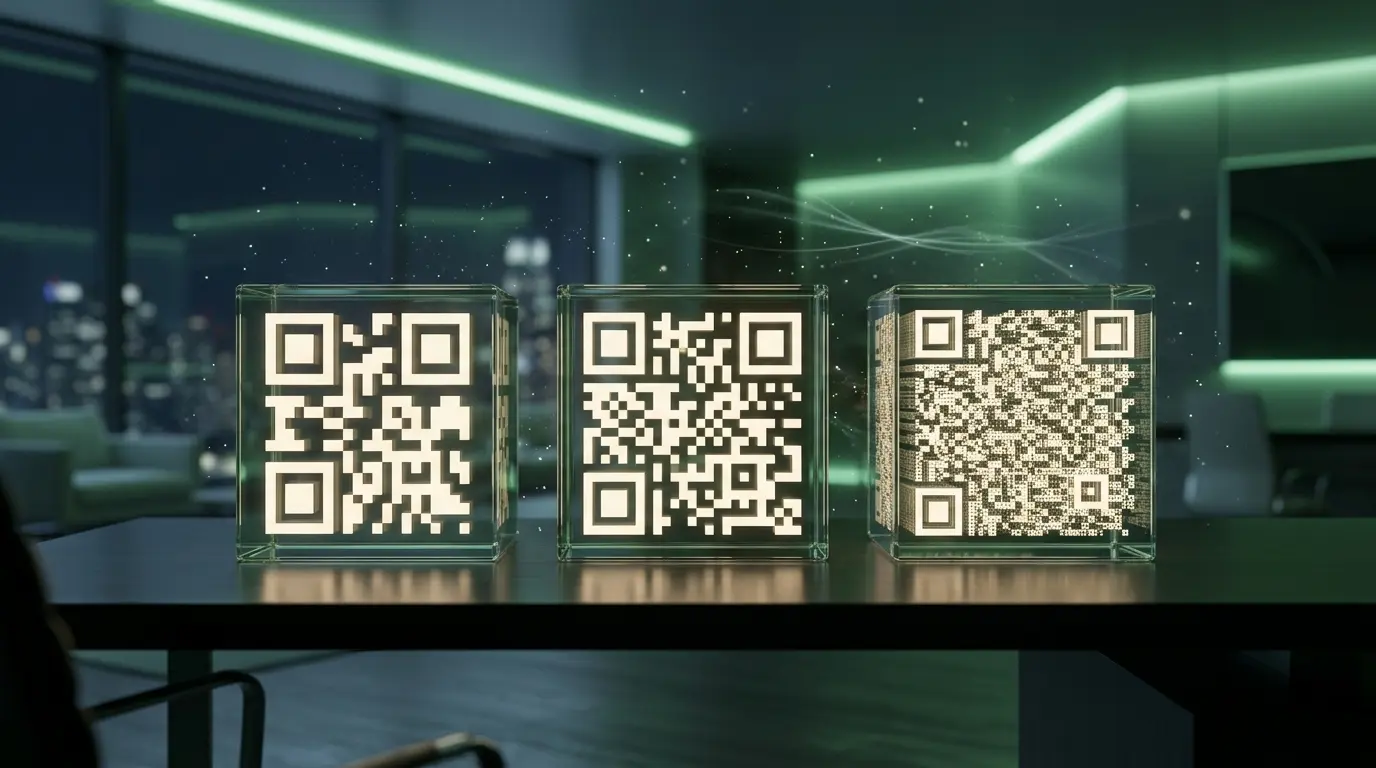
QR codes use a grid system consisting of so-called modules (the individual data points). To accommodate more data, the grid gradually expands. There are 40 different development stages (versions):
- Version 1 ---> 21 × 21 modules (very coarse grid, little data)
- Version 10 ---> 57 × 57 modules (medium density)
- Version 40 ---> 177 × 177 modules (extremely high resolution, maximum capacity)
With each level, four grid points are added per side. If a Version 40 code is printed on a small poster, the individual modules shrink to the size of a pinhead. The result: The smartphone camera requires perfect lighting conditions and a razor-sharp print to even be able to resolve the pattern.
The Invisible Airbag: Error Correction
QR codes have built-in protection against scratches, dirt, or wear and tear. Thanks to mathematical redundancies, data can still be reconstructed even if parts of the code are obscured.
However, this security comes at a price—it consumes storage space.
| Protection Class | Tolerance for Damage | Impact on Storage |
| L (Low) | Tolerates approx. 7% data loss | Maximum space for user data |
| M (Medium) | Tolerates approx. 15% data loss | The balanced standard |
| Q (Quartile) | Tolerates approx. 25% data loss | Visible loss of space |
| H (High) | Tolerates approx. 30% data loss | Consumes more than half of the storage |
Choosing maximum reliability (Level H) reduces the storage volume of a Version 40 code from 2,953 bytes to just 1,273 bytes.
Practical Tip: Why “less” is almost always better
Just because a QR code can store thousands of characters doesn’t mean you should. To ensure reliable scanning on flyers, business cards, or packaging, a streamlined design is recommended.
- Use short destination URLs: Instead of including long parameter strings directly, shortened links keep the grid simple and scannable.
- Use dynamic redirects: With dynamic QR codes, only a compact server link is embedded in the pattern. The actual content resides on the server and can be updated at any time without having to reprint the code.
- Plan for graphic elements: If a logo is to be placed in the center, this requires error correction level H—the actual link must then be correspondingly shorter.
Practical Check: The Most Important Facts at a Glance
Can you store an entire document in a QR code?
Theoretically, short, plain-text content can be embedded. However, since the upper limit is just under 3 kilobytes, storing images or formatted PDFs directly in the code is technically impossible.
Why do some QR codes scan instantly while others take much longer?
The smaller the data volume and the lower the version, the larger the individual contrast points. Large-area modules can be scanned immediately even in low light or while in motion.
Does a dynamic QR code increase storage capacity?
Not within the code itself. It uses the same standard but stores the data on an external landing page or database, such as that provided by QRown. This keeps the printed pattern minimalistic.